


Focused on delivery of therapeutic cells to disease sites and amplifying the inherent power of the patients’ cells to effectively eliminate, cure, and even prevent diseases.
Our Technology Founders Dr. Rodger McEver and Dr. Lijun Xia at Oklahoma Medical Research Foundation discovered that the missing layer in cell therapy success is the need for effective cell delivery/trafficking to diseased tissues. Their scientific evidence showed that most cell therapies fail not because of potency but because of delivery ie.. cells don’t go where we think they go. Majority of cells are lost systematically. When they do reach diseased sites, most do not engraft successfully.
Indeed, it is estimated from multiple publications that less than 1-2% of intravenously infused therapeutic cells successfully home to the bone marrow, tumor sites, and sites of inflammation or disease, with limited or delayed cell engraftment and penetration in target tissues or diseased organs. With CNS related diseases, it is estimated that much less than 0.5% of therapeutic cells reach CNS diseased sites due to the blood-brain barrier.
As a leading glycobiologist, Dr. McEver knew that inflammation, infections, malignancies, tissue injuries trigger endothelial cells to upregulate selectins, molecules that define vascular ‘zip codes’ for immune cell entry to diseased tissues.
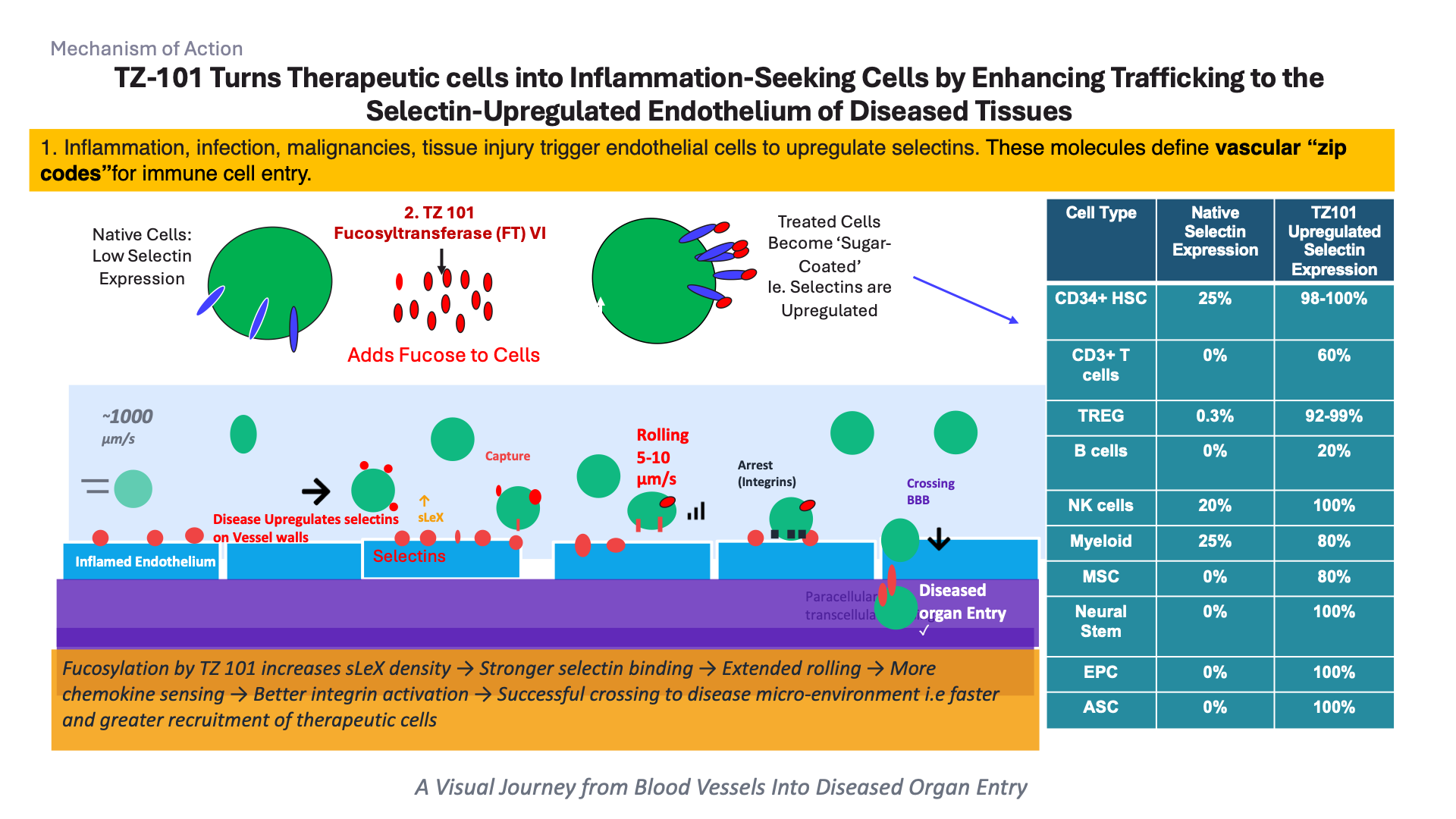
Mechanistically, TZ 101 serves as the ‘GPS’ of therapeutic cells, multiplying their effective delivery to diseased sites by 400-1200%. It transforms therapeutic cells into inflammation-seeking cells by enhancing trafficking to the selectin-upregulated endothelium of diseased tissues. Inflammation, infection, malignancies, and tissue injury trigger endothelial cells to upregulate selectins. These selectin molecules serve as vascular “zip codes” for immune cell entry into these diseased sites.
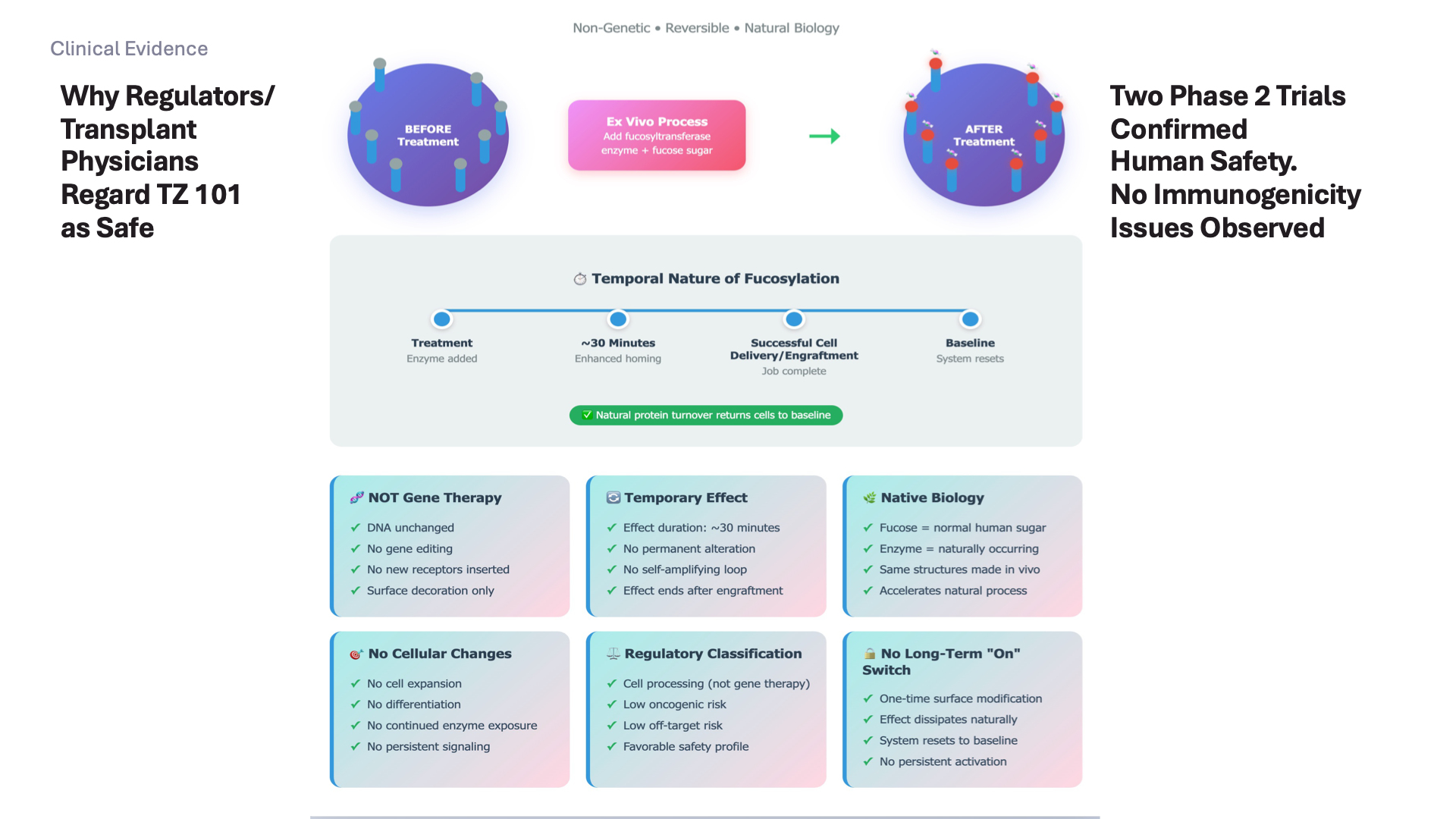
Our proprietary cell efficacy multiplier fucosylation platform technology is founded on a distinctive combination of fucosyltransferase enzymes and small molecules to enhance the surface properties of therapeutic cells, empowering them to navigate more efficiently and effectively through the bloodstream to successfully reach target tissues or disease sites faster and in greater numbers. With precise targeting capabilities for specific diseased tissues and organs, the use of our fucosylation platform technology increases adoptive cell extravasation from the vasculature to the chemokine-expressing diseased sites, enabling preferential targeting to and improved penetration into tumors or organs affected by disease. Additionally, our cell efficacy multiplier platform technology has shown in multiple preclinical and clinical studies to improve adoptive cell engraftment and better intra-tumor/intra-diseased organ penetration, resulting in better cell therapy efficacy outcomes across multiple therapeutic cell types for a wide range of clinical indications.
While Targazyme has been laser-focused on the development of our medicine to cure cancer patients, we have proven that our cell efficacy multiplier platform technology multiplies efficacy outcomes for multiple cell types, such as HSCs, NK cells, T-cells, B-cells, MSCs, T-regs, and others, used for the treatment of multiple diseases, including cancer, autoimmune diseases, blood disorders, cardiovascular diseases, and regenerative medicine. Data generated at Targazyme and replicated at esteemed institutions, such as MD Anderson Cancer Center, Harvard, OMRF, and the University of Pennsylvania, indicate that fucosylated therapeutic cells exhibit 400-1200% greater delivery to diseased sites, 500% increased residence time along with this same proportional increase in intra-tumor or intra-diseased tissue penetration compared to untreated cells. These enhancements contribute to better efficacy outcomes in the treatment of various diseases.
Moreover, published studies in esteemed journals such as Blood and Clinical Cancer Research further support the effectiveness of our cell efficacy multiplier fucosylation platform technology in enhancing the potency of therapeutic cells. Fucosylated NK and T cells demonstrate increased effectiveness as cancer tumor killers when compared to their non-fucosylated counterparts. Additionally, fucosylated stem cells display faster and more efficient engraftment within the bone marrow, leading to accelerated hematopoietic recovery post-Hematopoietic Stem Cell (HSC) treatment in comparison to non-fucosylated stem cells. This is important to help prevent the incidence of side effects associated with standard of care cancer therapies, such as infections, engraftment failure, and hemorrhaging. Fucosylated Regulatory T-cells and MSCs have also been shown to home more effectively to auto-immune disease sites, such as GVHD, with improved engraftment, increased residence time, and better disease control.
Finally, for neurodegenerative diseases, TZ 101 has been shown to enable Tregs to overcome the blood brain barrier resulting in 200-400% Improved delivery of Tregs to the CNS with 5X increased residence time to restore sustained immune tolerance, multiplied neuroprotection in the CNS, all important to prevent neurodegeneration for patients with diseases such as MS, Parkinsons and Alzheimers.
These scientific findings highlight the significant impact of our fucosylation cell efficacy multiplier platform technology in enhancing the capabilities and effectiveness of therapeutic cells across various applications and its potential to transform the whole field of cell therapy and patient outcomes. Targazyme’s commitment to rigorous research and innovation drives our mission to transform patient outcomes and revolutionize the field of cell-based therapies.